3D & Animation · Web · Automation & AI — 2026
ZamaRig
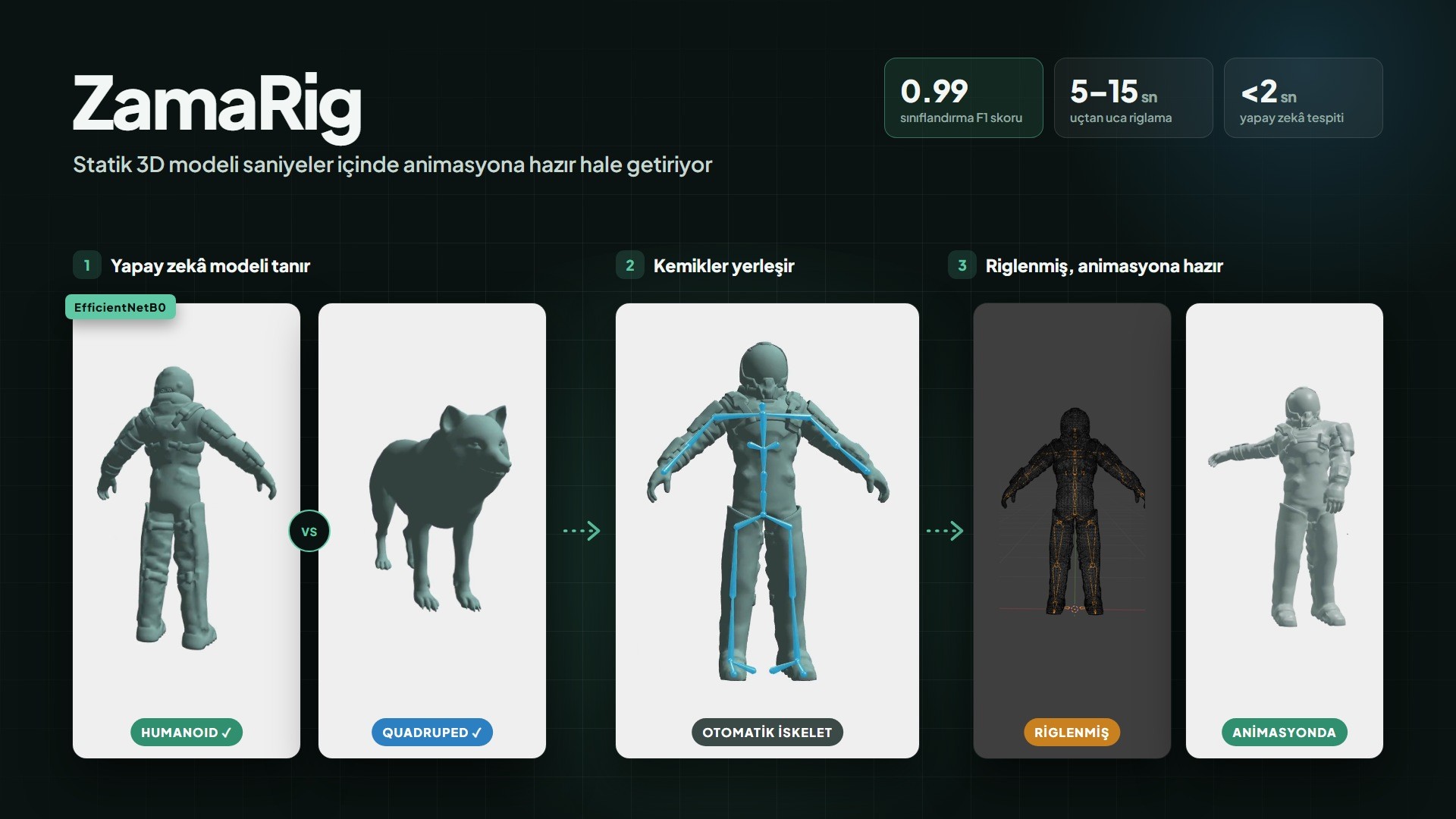
You upload a static 3D model; the AI I trained recognizes whether it is a humanoid or a quadruped, places the skeleton and gives you an animation-ready model in seconds.
The problem
Preparing a 3D character for animation (rigging) means placing bones and painting weights by hand, which takes even an experienced artist 2–8 hours. ZamaRig brings that process down to a single click.
How it works
- Upload: the .obj or .fbx model is sent to the server.
- Multi-angle render: Blender centers the model in the background and renders it from 4–6 angles.
- Classification: an EfficientNetB0 model I trained with transfer learning decides, with a confidence score, whether the model is a humanoid or a quadruped.
- Skeleton: the right template is fitted to the model's proportions. A-pose and T-pose are detected; finger, spine and tail bones get special handling.
- Weight painting: distance-based (geodesic) weights are calculated so joints bend naturally.
- Export: the rigged model is previewed in the browser and downloaded as FBX.
Results
- 0.99 F1 score on 320 renders it had never seen before
- Classification in under 2 seconds
- End-to-end rigging in 5–15 seconds (2–8 hours by hand)
The landing page
I put the 3D side front and center: a model animation driven by scrolling, a shader "melt" transition between models, skeleton visualization and smooth scrolling.
Note
The landing page is live. Since the rigging engine needs Blender and TensorFlow, it runs as a local install; the setup steps are on GitHub.
Next projectCustomPoly →